Vintage Journal Papers: A Comprehensive Evaluation for Creative Projects
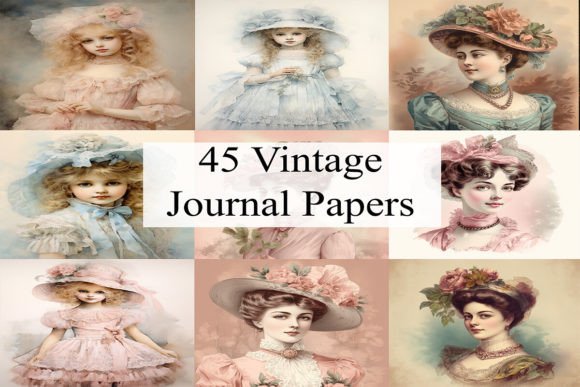
The digital asset market has expanded significantly, offering a vast array of resources for designers, crafters, and content creators. Among the most popular categories is Vintage Journal Papers. This specific collection represents a curated set of 45 distinct designs intended to replicate the aesthetic of historical documents. Unlike modern stock photography or generic textures, these papers are generated using advanced artificial intelligence tools, specifically Midjourney, to create unique visual narratives that evoke the past.
For individuals researching this product category, understanding the technical specifications and creative applications is essential before making a purchase decision. This evaluation explores what constitutes a high-quality Vintage Journal Papers bundle, the practical benefits of using AI-generated assets, and the specific scenarios where this resource aligns with user goals versus when alternatives might be preferable.
Understanding the Product Specifications
When evaluating a bundle labeled as Vintage Journal Papers, the first step is to examine the technical attributes that define its utility. The standard specification for this particular set includes 45 individual files. Each image is provided in PNG format, which is critical for design flexibility. PNG files support transparency, allowing users to overlay the paper texture onto other elements without visible rectangular borders.
The resolution is another key factor. These images are sized at 2550x3300 pixels with a density of 300 DPI (dots per inch). In the context of print production, 300 DPI is the industry standard for high-quality output. This ensures that when the paper is printed for physical projects like scrapbooks or invitations, the grain and detail remain sharp rather than becoming pixelated or blurry. The aspect ratio is vertical, mimicking the dimensions of traditional journal pages or letterhead, which makes them immediately usable for document-based layouts.
Primary Use Cases and Applications
The versatility of Vintage Journal Papers stems from their ability to serve multiple functions across different media. Because they are designed to look like aged, textured surfaces, they provide an instant atmospheric backdrop for various creative endeavors.
- Scrapbooking and Cardmaking: Physical crafters often struggle to find consistent, high-resolution textures that match their vintage themes. These digital papers can be printed on cardstock or photo paper to create backgrounds for photo albums, greeting cards, and memory boxes.
- Digital Design and Web Graphics: For web designers, these assets offer a quick way to establish a retro aesthetic. They can be used as headers for blogs, backgrounds for email newsletters, or textures for digital invitations.
- Planner Stickers and Stationery: The 300 DPI resolution allows for the creation of custom planner stickers, business cards, and letterheads that require professional print quality.
- Fabric Printing and Home Decor: Due to the high resolution, these images can be scaled for sublimation printing on fabric, enabling the creation of custom textiles, tote bags, or home decor items featuring Victorian-era aesthetics.
The Role of Generative AI in Modern Assets
A defining characteristic of this specific collection is its origin. These images were created using Midjourney, a generative art program. This distinction is important for buyers to understand, as it influences both the uniqueness and the consistency of the output.
Benefits of AI Generation: Traditional vintage papers are often scanned from real books, which can result in imperfections like coffee stains, torn edges, or inconsistent lighting. While some users seek these flaws, others prefer a cleaner, more controlled look. AI generation allows for the creation of "perfect" vintage textures—consistent lighting, uniform aging, and repeatable patterns—that maintain a cohesive theme across all 45 sheets. Furthermore, because the images are generated digitally, they are inherently vector-friendly in terms of scalability up to the pixel limit, ensuring no loss of quality during resizing.
Considerations Regarding Authenticity: It is worth noting that AI-generated images may lack the specific historical provenance of actual scanned artifacts. If a project requires absolute historical accuracy regarding typography or specific period-accurate paper fibers, a human-made scan might be superior. However, for general decorative purposes where the vibe of the Victorian era is desired, the AI output provides a highly effective and efficient solution.
Evaluating Tradeoffs and Expectations
Before selecting this bundle, potential users should weigh the advantages against potential limitations. The primary tradeoff lies between uniqueness and control. While the 45 variations offer a good range of styles, AI generation does not always guarantee specific details. A user cannot request a specific date stamp or a specific floral arrangement with 100% precision; the AI interprets prompts to create a general aesthetic.
Another consideration is file management. Receiving 45 high-resolution PNG files can result in a large download size. Users should ensure they have adequate storage space and a workflow system to organize these files before importing them into design software. Additionally, while the images are 300 DPI, they are raster-based. If a user attempts to scale a single image significantly beyond its original dimensions for massive signage, the pixel count will eventually become a limiting factor, though 2550x3300 pixels covers most standard commercial needs.
Situations Where This Bundle Is a Strong Fit
This collection is an ideal choice for professionals and hobbyists who need to produce a high volume of content quickly. For example, a small business owner launching a line of vintage-themed stationery would benefit from the consistency of the 45-sheet set. The ability to generate 45 distinct but thematically linked backgrounds saves hours of manual searching and editing time compared to sourcing individual textures from various free or paid libraries.
It is also a strong fit for educators and students creating digital learning materials. Teachers designing worksheets, history presentations, or interactive storyboards can utilize these papers to immerse students in a specific historical period without needing expensive physical props. The clean, transparent PNG format allows for easy integration into presentation software like PowerPoint or Canva.
When to Consider Alternatives
Despite the versatility of Vintage Journal Papers, there are scenarios where alternative resources may be more appropriate. If a project demands exact replication of a specific historical document—for instance, reproducing a genuine 19th-century legal contract—the user should look for licensed archives or museum digitization projects rather than AI-generated interpretations.
Similarly, if the design goal is to achieve a hyper-realistic, gritty texture with random, organic imperfections that feel "lived-in," a library of scanned real-world paper might offer more variety. AI images, by nature, tend to have a certain level of mathematical perfection or pattern repetition that can sometimes look slightly artificial upon close inspection. For ultra-high-end editorial work where every pixel is scrutinized, sourcing individual, hand-sourced scans might yield better results.
Practical Decision-Making Insights
To determine if this bundle aligns with your current goals, consider the following checklist:
- Do you need transparency? If yes, the PNG format is essential. If you only need flat JPEGs, a cheaper option might suffice.
- Is print quality non-negotiable? Verify that the 300 DPI meets your printer's requirements. Most home printers and local print shops accept this standard.
- Are you looking for thematic consistency? If you need a cohesive set of 45 backgrounds for a larger project, this bundle offers a unified look that is difficult to curate manually.
- What is your budget? Compare the cost of this bundle against purchasing individual licenses for similar assets. Buying a bundle is generally more cost-effective for bulk usage.
In conclusion, the Vintage Journal Papers bundle represents a robust tool for modern creatives seeking to incorporate historical aesthetics into their work. By leveraging AI technology, it provides a scalable, high-resolution solution that balances the charm of the Victorian era with the efficiency of digital design. Whether for personal scrapbooking or commercial web graphics, understanding the strengths and limitations of these assets ensures that the final product meets the intended vision.